5. Multiple comparison tests: Scheffe
The Scheffe method is used when we are interested in evaluating all Possible contrasts of the experiment. When there is only one test On the contrary, differences in pairs of media are analyzed. treatment.
Example:
Let us consider the production process of a synthetic fiber, in which the The experimenter wants to know the influence of the percentage of cotton on fiber resistance. For this, an experiment was carried out completely random, in which different levels of cotton percentage were evaluated. evaluated with respect to fiber strength. An important point in The planning of the experiment is that for each factor level (percentage cotton), the other factors that influence the process (such as the environment environment, machine, raw material, etc.) must present a standard homogeneous of variability. In the experiment, we take 5 levels for the cotton percentage and 5 repetitions.
| Factor | Resistance |
|---|---|
| 15 | 7 |
| 15 | 7 |
| 15 | 15 |
| 15 | 11 |
| 15 | 9 |
| 20 | 12 |
| 20 | 17 |
| 20 | 12 |
| 20 | 18 |
| 20 | 18 |
| 25 | 14 |
| 25 | 18 |
| 25 | 18 |
| 25 | 19 |
| 25 | 19 |
| 30 | 19 |
| 30 | 25 |
| 30 | 22 |
| 30 | 19 |
| 30 | 23 |
| 35 | 7 |
| 35 | 10 |
| 35 | 11 |
| 35 | 15 |
| 35 | 11 |
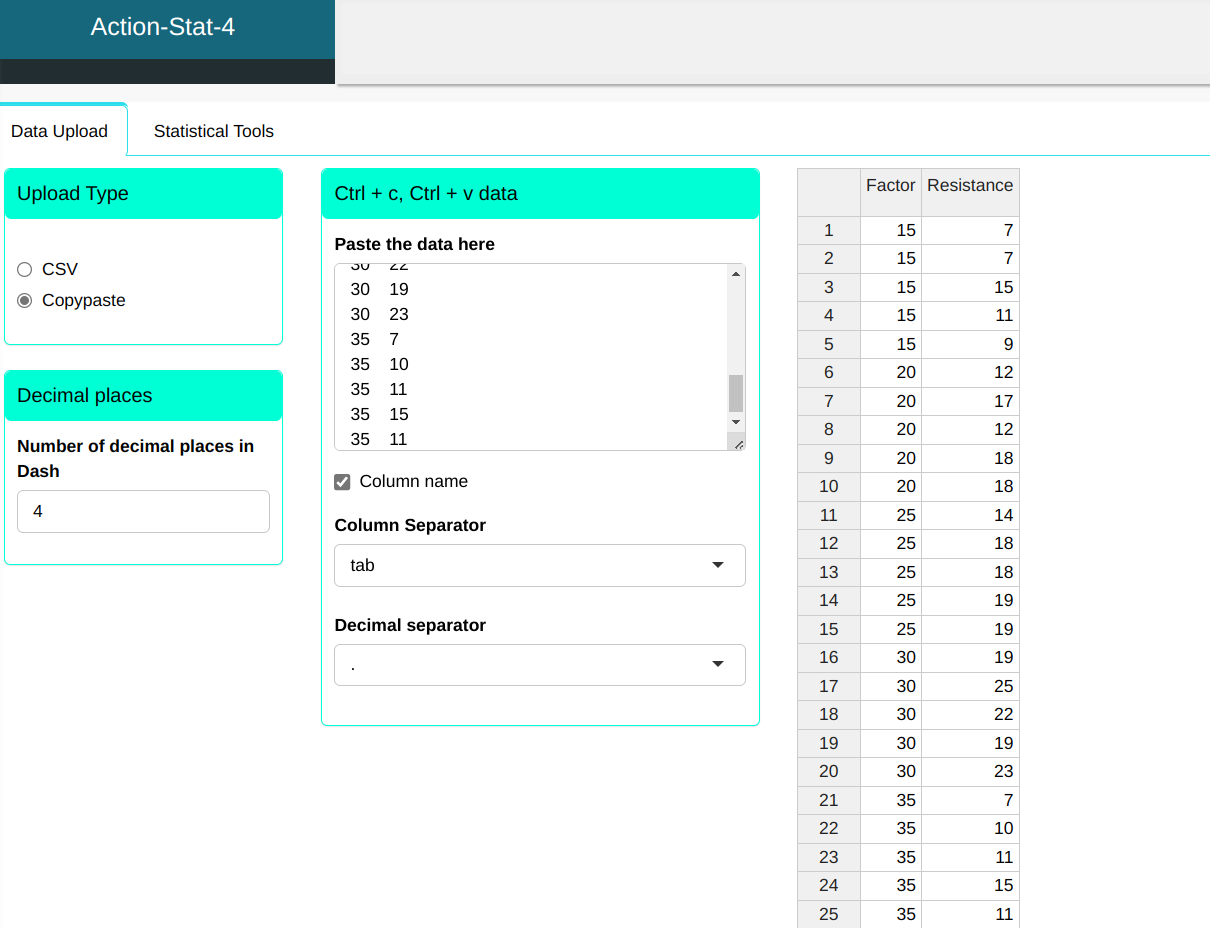
We will do the Sheffe test.
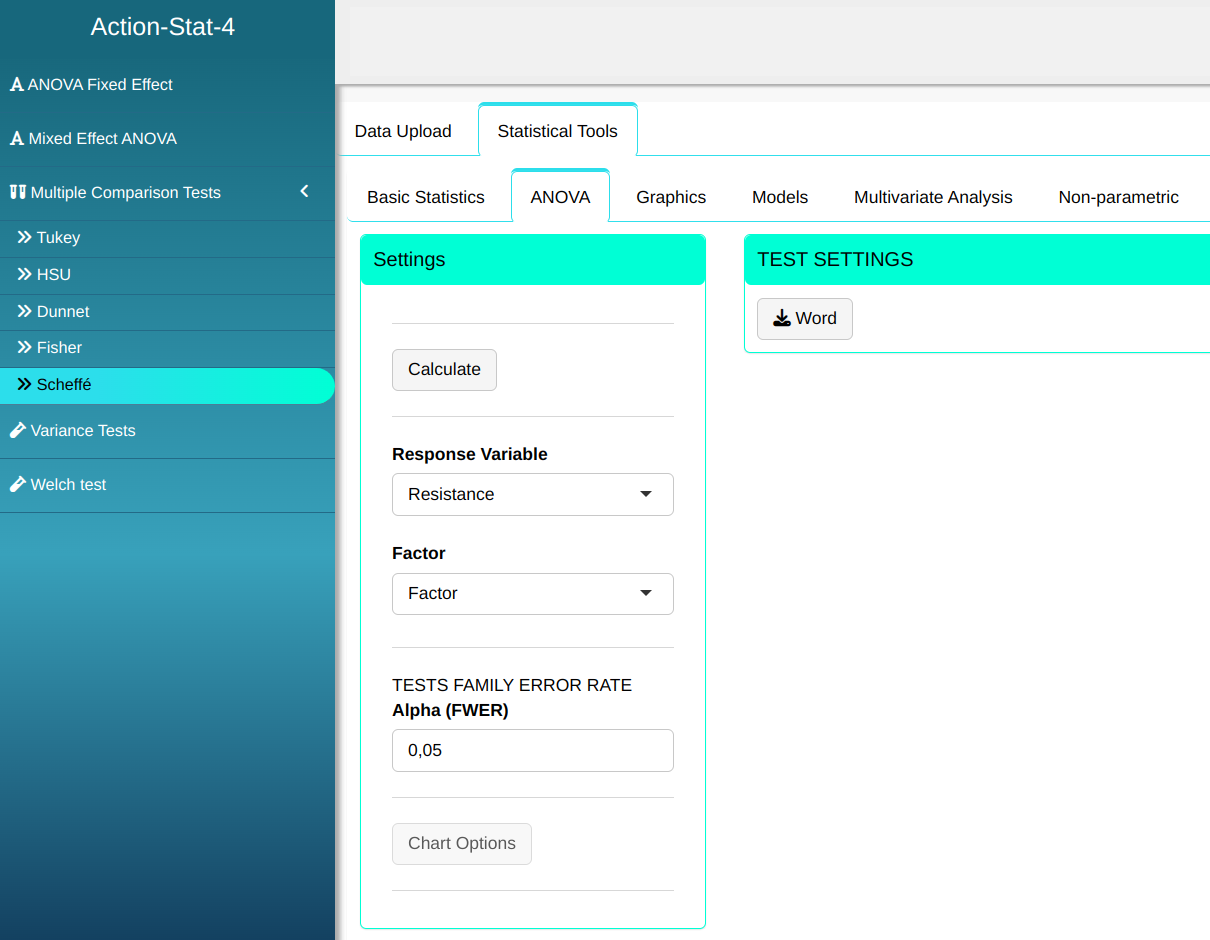
Then click Calculate to get the results. You can also generate the analyses and download them in Word format.

The results are:
Anova table
| GL | Sum of squares | Mean Square | F Stat. | P-value | |
|---|---|---|---|---|---|
| Factor | 4 | 475.76 | 118.94 | 14.757 | 0 |
| Residuals | 20 | 161.20 | 8.06 |
Multiple comparisons
| Center | Lower limit | Upper limit | P value | |
|---|---|---|---|---|
| 20 - 15 | 5.6 | -1.008 | 12.208 | 0.081 |
| 25 - 15 | 7.8 | 1.192 | 14.408 | 0.008 |
| 30 - 15 | 11.8 | 5.192 | 18.408 | 0.000 |
| 35 - 15 | 1.0 | -5.608 | 7.608 | 0.988 |
| 25 - 20 | 2.2 | -4.408 | 8.808 | 0.823 |
| 30 - 20 | 6.2 | -0.408 | 12.808 | 0.044 |
| 20 - 35 | 4.6 | -2008 | 11.208 | 0.203 |
| 30 - 25 | 4.0 | -2.608 | 10.608 | 0.326 |
| 25 - 35 | 6.8 | 0.192 | 13.408 | 0.023 |
| 30 - 35 | 10.8 | 4.192 | 17.408 | 0.000 |
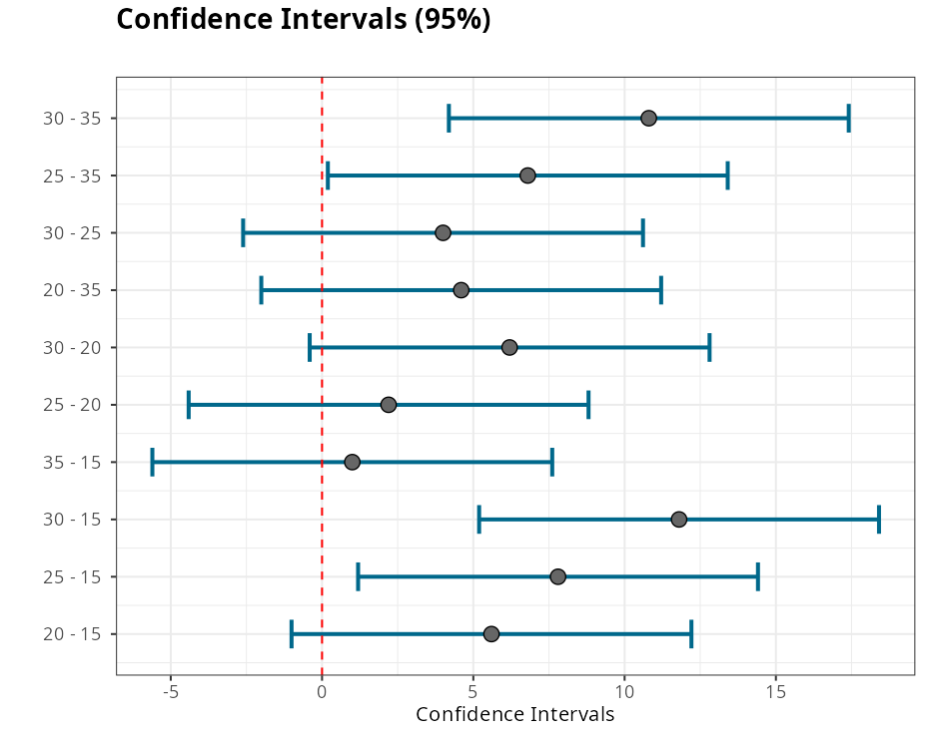
The Scheffe test applied in this example tests only one contrast, or that is, like the previous tests we are evaluating the equality between levels. In these results we see that the equality hypothesis is rejected among the levels that have a P value greater than alpha, that is, that is, levels 25-15,30-15,30-20,25-35 and levels 30-35;
NOTE: Since only pairwise comparisons are made in this example, the Evaluation by confidence interval is not recommended for this method, since it provides confidence intervals that are not very "narrow" compared to other methods. Therefore, when Only two-by-two comparisons are made, the Tukey test is recommended. When many or all contrasts are of interest, the The Scheffe method tends to give narrower confidence limits and is, therefore the preferred method.