6. ID Plot
Way to verify, through probability paper, a distribution which best describes the randomness of a data set.
Example:
We consider the dataset in the following table. Let’s check Which probability distribution best describes this set of data.
| Medicines |
|---|
| 0.20 |
| 0.16 |
| 0.24 |
| 0.56 |
| 0.34 |
| 0.33 |
| 0.35 |
| 0.20 |
| 0.28 |
| 0.81 |
| 0.30 |
| 1.19 |
| 0.46 |
| 0.12 |
| 0.50 |
| 0.46 |
| 0.69 |
| 0.11 |
| 0.32 |
| 0.28 |
| 0.57 |
| 0.42 |
| 0.91 |
| 0.79 |
| 0.51 |
| 0.67 |
| 0.70 |
| 0.19 |
| 0.22 |
| 0.62 |
| 0.56 |
| 0.96 |
| 0.11 |
| 0.85 |
| 0.37 |
| 0.80 |
| 0.52 |
| 0.17 |
| 0.58 |
| 0.15 |
| 0.20 |
| 0.05 |
| 0.63 |
| 0.53 |
| 0.60 |
| 0.21 |
| 0.29 |
| 0.41 |
| 0.43 |
| 0.75 |
We will upload the data to the system.
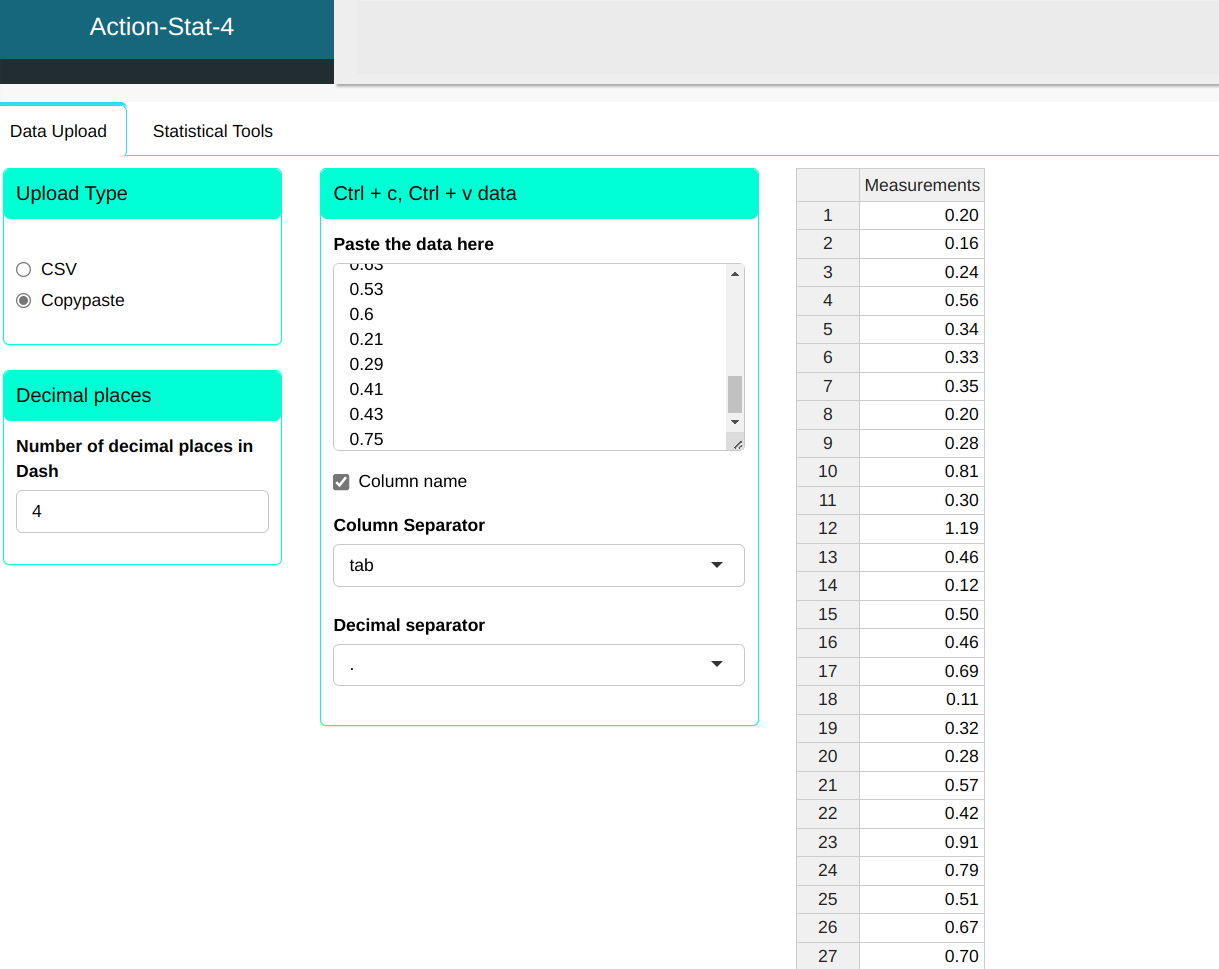
Configuring according to the figure below and we will do the ID plot
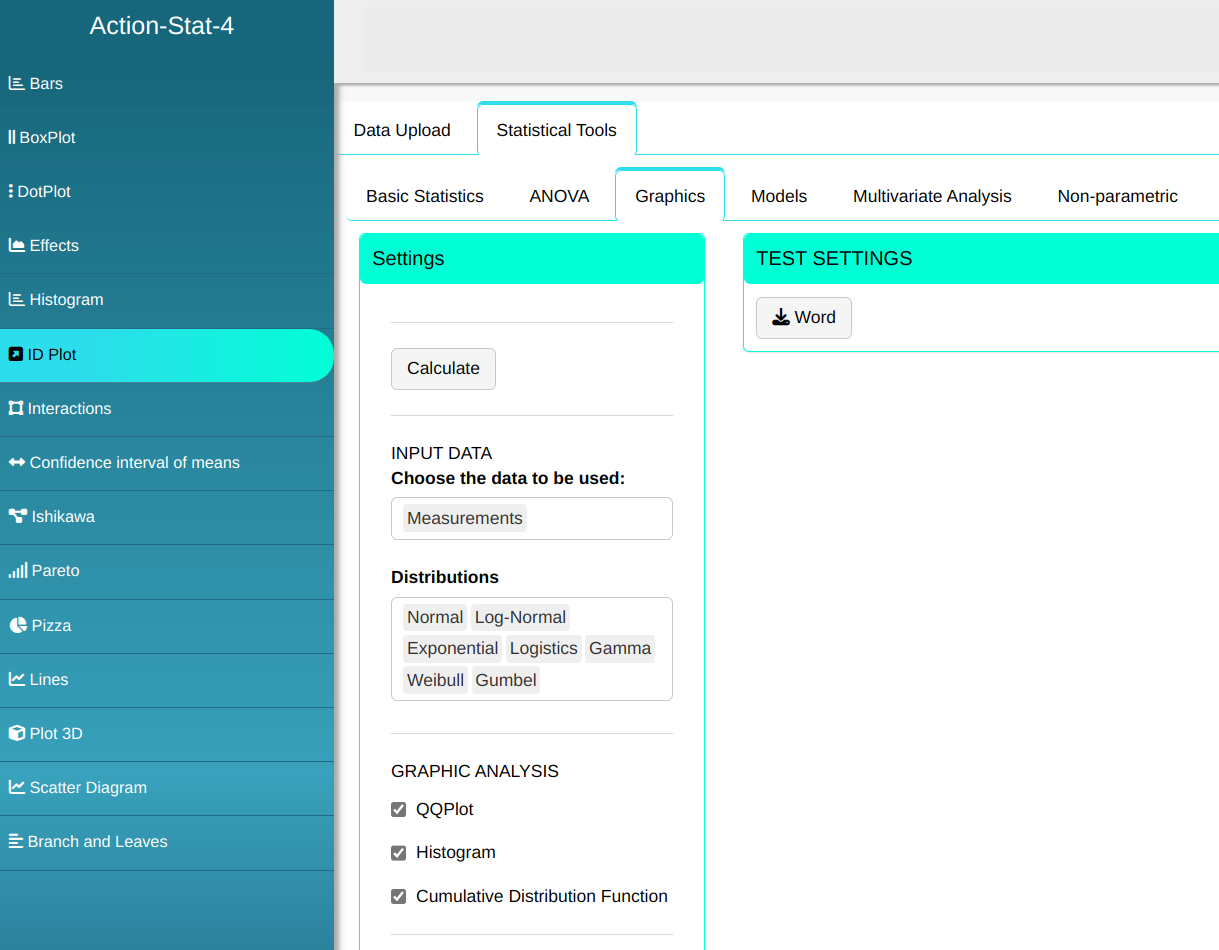

Then click Calculate to get the results. You can also generate the analyses and download them in Word format.

The results are:
Analysis result
| Box-Cox Transformation |
Results
| Values | |
|---|---|
| Lambda | 0.429 |
| P-Value (Anderson-Darling) | 0.703 |
Analysis result
| Johnson Transformation |
Estimates
| test | |
|---|---|
| Gamma | 0.90802942754439 |
| Lambda | 1.36936290670753 |
| Epsilon | 0.0168457063069285 |
| Eta | 0.951739827664239 |
| Family | SB |
| P-Value (Anderson-Darling) | 0.9422 |
Anderson-Darling
| Distributions | Statistics | P-Value | |
|---|---|---|---|
| 1 | Normal( $\mu$ = 0.45, $\sigma$ = 0.26) | 0.566 | 0.136 |
| 2 | Log-Normal(log($\mu$) = -0.982398, log($\sigma$) = 0.667801) | 0.589 | 0.118 |
| 1-mle-exp | Exponential(Rate = 2.20556) | 3,845 | 0.000 |
| 11 | Logistics(Location = 0.44, Scale = 0.15) | 0.581 | 0.089 |
| 12 | Gamma(Shape = 2.76743, Rate = 6.10372) | 0.295 | 0.250 |
| 13 | Weibull(Shape = 1.84755, Scale = 0.511436) | 0.217 | 0.250 |
| 14 | Gumbel(Location = 0.332819, Scale = 0.207431) | 0.384 | 0.250 |
Cramer-von-Misés
| Distributions | Statistics | P-Value |
|---|---|---|
| Normal($\mu$ = 0.45, $\sigma$ = 0.26) | 0.082 | 0.192 |
| Log-Normal(log($\mu$) = -0.982398, log($\sigma$) = 0.667801) | 0.100 | 0.114 |
| Exponential(Rate = 2.20556) | 0.678 | 0.000 |
| Logistics(Location = 0.44, Scale = 0.15) | 0.076 | 0.232 |
| Gamma(Shape = 2.76743, Rate = 6.10372) | 0.051 | 0.497 |
| Weibull(Shape = 1.84755, Scale = 0.511436) | 0.035 | 0.765 |
| Gumbel(Location = 0.332819, Scale = 0.207431) | 0.065 | 0.329 |
Kolmogorov-Smirnov
| Distributions | Statistics | P-Value |
|---|---|---|
| Normal($\mu$ = 0.45, $\sigma$ = 0.26) | 0.095 | 0.313 |
| Log-Normal(log($\mu$) = -0.982398, log($\sigma$) = 0.667801) | 0.108 | 0.158 |
| Exponential(Rate = 2.20556) | 0.202 | 0.000 |
| Logistics(Location = 0.44, Scale = 0.15) | 0.082 | 0.550 |
| Gamma(Shape = 2.76743, Rate = 6.10372) | 0.083 | 0.534 |
| Weibull(Shape = 1.84755, Scale = 0.511436) | 0.070 | 0.778 |
| Gumbel(Location= 0.332819, Scale = 0.207431) | 0.081 | 0.559 |
Analysis result
| Graphic Analysis |
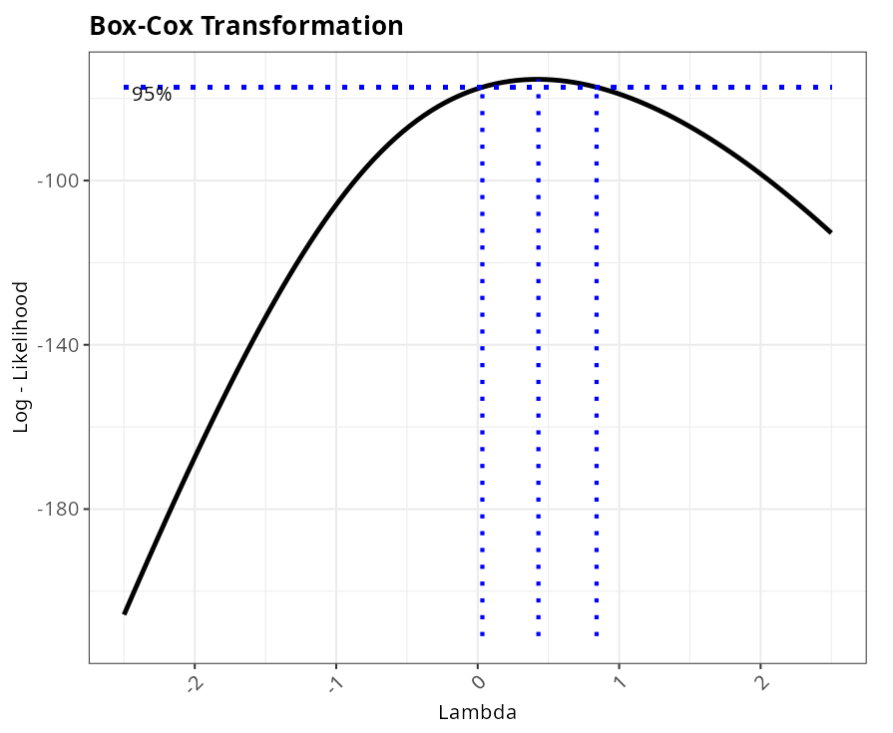
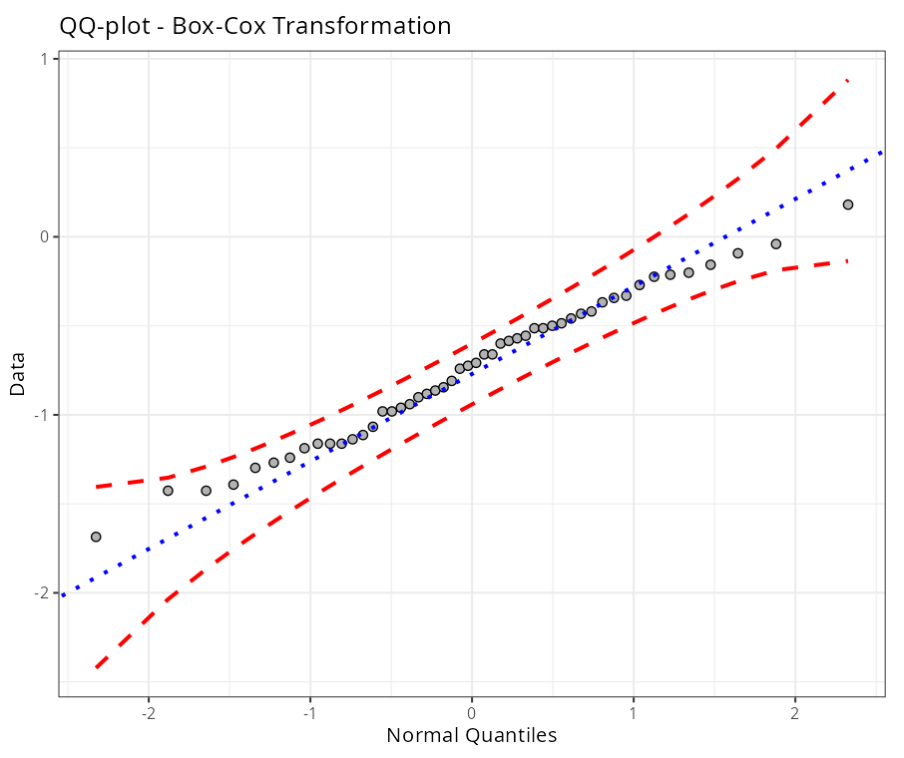
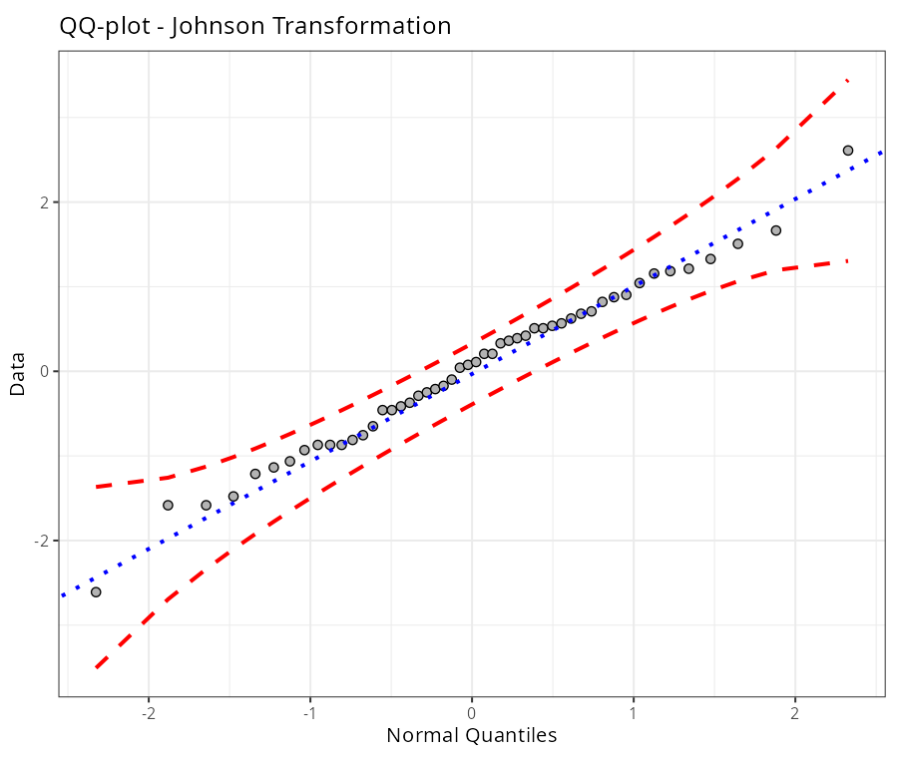
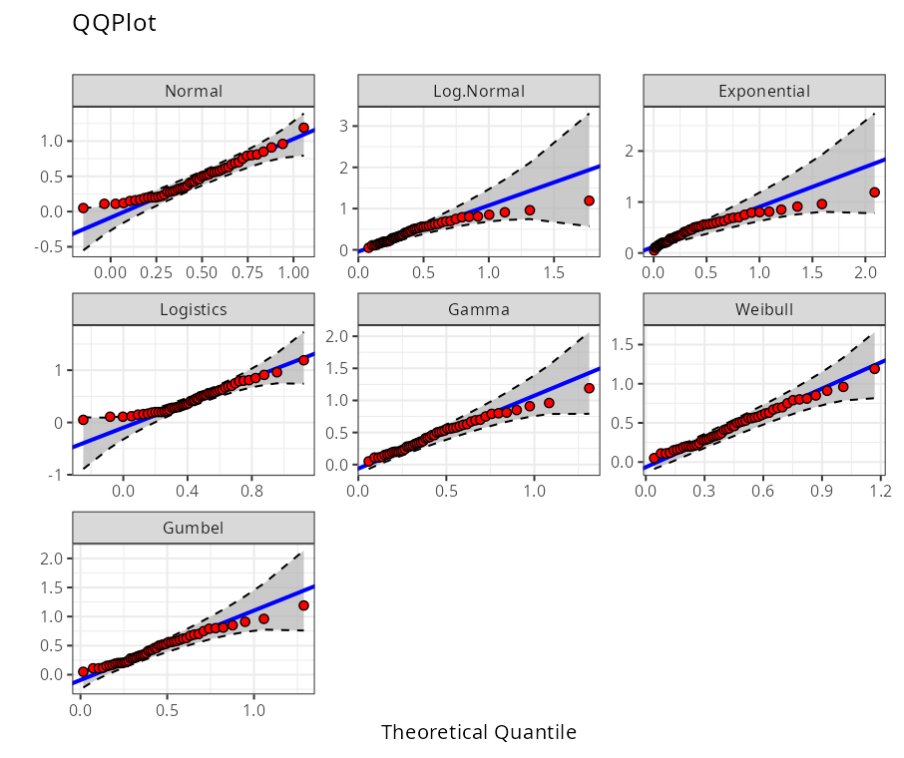
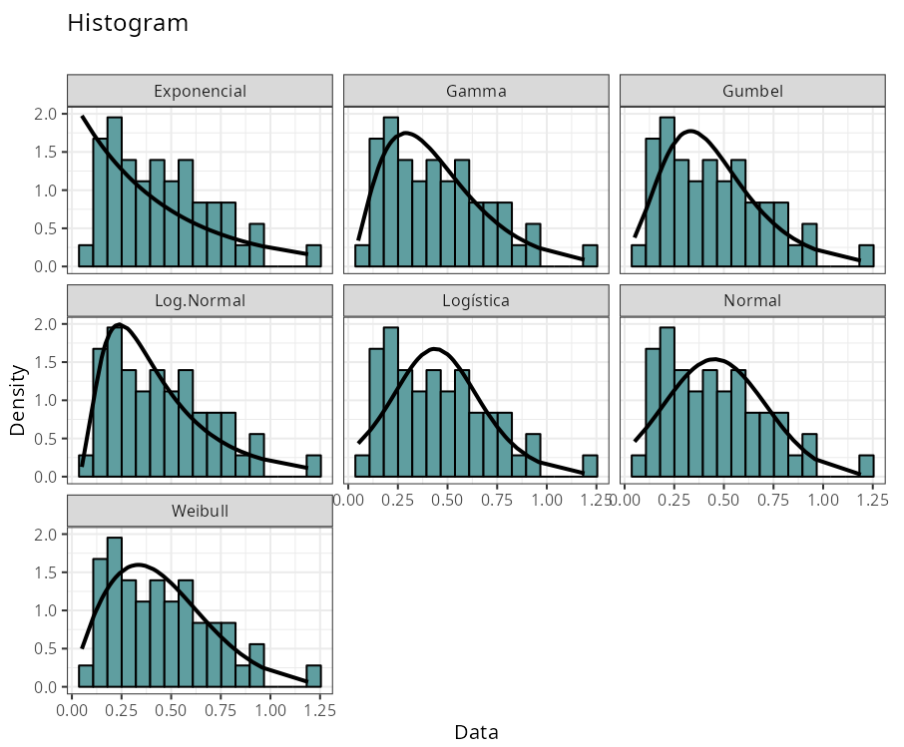
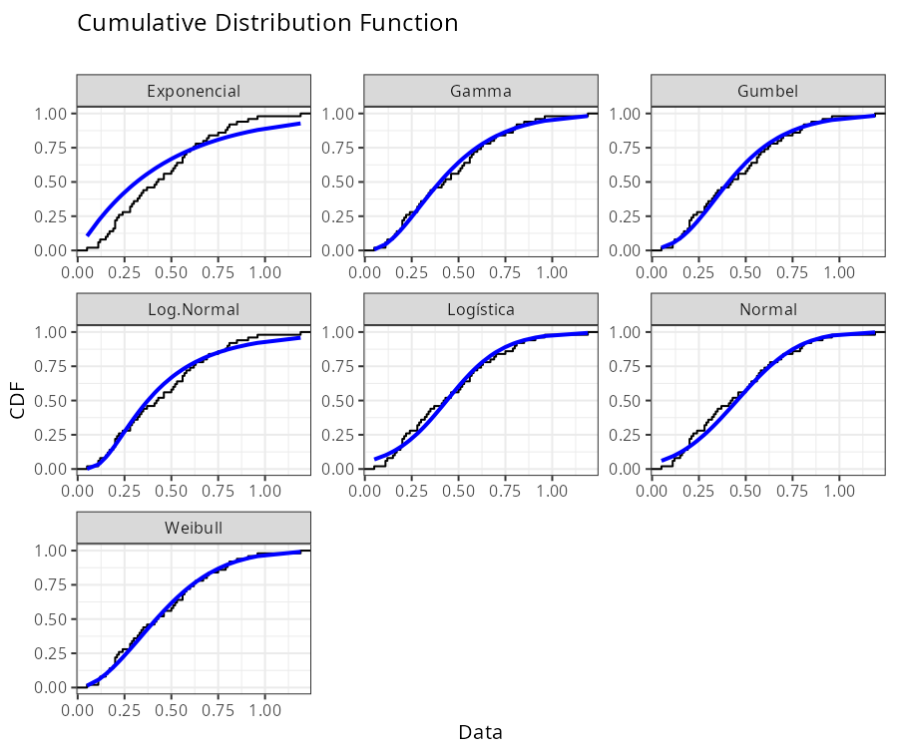
Data transformed using Box-Cox Transformation and Johnson transformations follow a normal distribution. This result can be confirmed by observing the p-value associated with the Anderson-Darling.
The table indicates that the data can be better fitted by all distributions except Exponential Distribution, which can be confirmed when we compare the p-value of the Anderson-Darling test with the level of significance of 0.05.